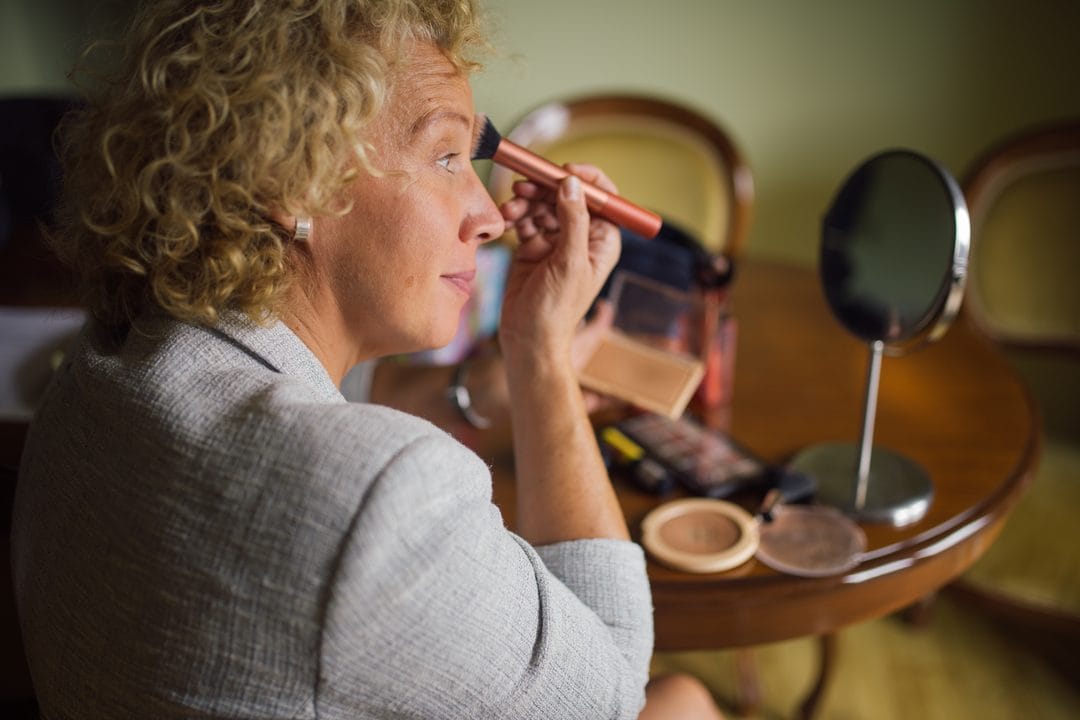
By eleven in the morning, your foundation has usually made its decision. It's either sitting where you put it, or it's pooled into your smile lines and slid off your nose, leaving a shiny strip down the center of your face while the rest looks patchy. In July and August, this isn't a technique failure — it's chemistry. Sebum production rises with skin temperature, and once your face crosses roughly 93°F, oil output can climb by 10% or more compared to a cooler day. Add humidity above 60%, and most standard foundations simply can't hold their structure against that combination.
Why makeup breaks down faster in summer
Foundation is an emulsion — oil and water bound together with a stabilizer — and heat is the enemy of emulsions. As your skin warms, the oil phase becomes more mobile and starts separating from the pigment and water components, which is why a foundation that looked matte at 8 a.m. can look greasy and gray by 1 p.m. Sweat compounds the problem because it's not just water; it carries salts and sebum to the surface, effectively re-emulsifying whatever you applied hours earlier. This is also why a formula that performs beautifully in a Chicago winter can fail completely in a Bangkok August, even from the same bottle.
There's a second factor people underestimate: the primer-to-foundation ratio. A silicone-based primer creates a smooth film that foundation sits on top of rather than bonding with, and in high heat that film can actually accelerate slipping once sweat gets underneath it. Water-based, gel primers behave differently — they let foundation grip the skin's surface more directly, which tends to hold up better once you're sweating rather than just standing under a hot light.
Start with skin, not with product
The single biggest lever for summer longevity isn't the foundation you choose. It's what happens on your skin in the ten minutes before you pick up a brush. Wash with a gentle, non-stripping cleanser, then apply a lightweight, oil-free moisturizer and let it fully absorb — rushing this step is the most common reason makeup slides, because product applied over half-absorbed moisturizer never really sets. If your T-zone runs oily, blot with a tissue right before priming; skipping this one step undoes half the benefit of a mattifying primer.
Sunscreen goes on next, and this is where a lot of summer routines quietly sabotage themselves. Chemical sunscreens with a wet, slippery finish will fight a matte foundation for the next six hours. Mineral formulas with zinc oxide, or hybrid sunscreens marketed as "makeup-friendly" — Supergoop's Unseen Sunscreen or La Roche-Posay's Anthelios Ultra-Light Fluid are both built with this in mind — dry down faster and give foundation something stable to sit on.
Choosing a formula built for heat
Not every long-wear foundation is actually built for humidity — some are built for oxidation resistance or for camera flash, which is a different problem. What you want for July heat is a formula explicitly engineered against sweat and transfer. Make Up For Ever's Ultra HD Foundation and Kosas Revealer Concealer both use polymer technology designed to form a flexible film that moves with skin instead of cracking or sliding. Charlotte Tilbury's Airbrush Flawless Foundation sits in the same category, with a matte-but-not-flat finish that photographs well without looking cakey by midday.
Skip anything labeled "dewy glow" or "luminous" for a beach trip or an outdoor wedding — those formulas are formulated with more oils and emollients specifically to catch light, and they're the first to break down once your skin heats up. That's a real trade-off worth naming: dewy finishes look genuinely beautiful in photos taken in the first hour, but by hour four in 90°F heat, that same glow reads as shine in all the wrong places. Save dewy formulas for air-conditioned events, and reach for a satin or natural-matte finish anywhere you'll be outside for more than an hour.
One counterintuitive fact worth remembering: heavier coverage often lasts longer than sheer coverage in heat, because a thicker pigment load resists breaking down visually even as the emulsion shifts underneath it. A sheer tinted moisturizer might feel more "summer appropriate," but it shows wear within an hour outdoors, while a medium-to-full coverage foundation can still look intact after three.
Setting technique matters more than the product itself
Powder is where most people either overdo it or skip it entirely, and both mistakes show up by early afternoon. Press — don't swipe — a translucent powder into the T-zone, chin, and any area prone to oil, using a fluffy brush and genuinely pressing the product in rather than dragging it across the skin. Dragging disturbs the foundation underneath and creates the exact patchiness you're trying to avoid. Laura Mercier's Translucent Loose Setting Powder and Huda Beauty's Easy Bake Powder are both formulated to grip oil without turning gray or flashback-white in photos.
Setting spray comes last, and it should be treated as a separate step from powder rather than a substitute for it. Hold the bottle eight to ten inches from your face and mist in an X-and-T pattern, then let it dry without touching your skin for thirty seconds. Urban Decay's All Nighter and Milk Makeup's Hydro Grip Setting Spray both hold up well in humidity testing, and layering one light mist before powder and one after gives noticeably better hold than a single heavy application.
The touch-up kit that actually works outdoors
A full reapplication in the middle of a hot day almost always looks worse than what you started with, because fresh foundation over shiny, partially-melted foundation just creates texture. Blotting papers — Clean & Clear's original sheets are still hard to beat at under $5 a pack — lift oil without disturbing pigment underneath, which a tissue or napkin can't do as cleanly. Press, don't wipe, and use a fresh sheet per area.
For real touch-ups, carry a cream concealer stick rather than liquid foundation; it's easier to control in heat and won't separate in a hot bag the way a liquid pump bottle will. Pat it into areas that have genuinely faded — usually the center of the forehead and the sides of the nose — then set with a small dusting of powder on a fluffy brush, not a fresh puff of the original powder you used that morning, which tends to build up and look chalky by the third application.
Dry heat and humid heat aren't the same problem
A base that survives a dry 100°F afternoon in Phoenix can fall apart within an hour in New Orleans at 85°F with 80% humidity, and treating both climates the same is a common planning mistake. Dry heat pulls moisture out of skin, which makes foundation cling to flaky patches and settle into fine lines around the eyes and mouth — the fix there is more hydration underneath, not less, plus a hydrating mist to refresh midday rather than more powder. Humid heat does the opposite: it adds moisture and oil to the skin's surface, which is what causes slipping and pooling rather than dryness-related patchiness, so the fix leans toward oil control and a flexible, sweat-resistant film rather than added hydration.
If you're traveling somewhere with a climate you don't normally deal with — say, moving from a dry Denver spring into a humid Miami summer — test your full routine at home first, ideally on a hot day with the air conditioning off for twenty minutes before application. It sounds excessive, but it's the only reliable way to know whether a foundation you already trust will actually hold up somewhere new, rather than finding out for the first time at a wedding.
Where people go wrong
The most common mistake isn't product choice — it's layering too many steps that all fight the same battle. Primer, foundation, concealer, powder, bronzer, setting spray, and a final powder is six to seven layers stacked on skin that's already working against you in the heat, and each additional layer is another point where things can slip. A simpler routine with fewer, better-chosen products almost always outlasts a heavier one. Skip a step you don't need rather than adding one you think might help.
Waterproof mascara and a cream or gel blush that sets to a natural finish round out a routine that's genuinely built for a day outside, whether that's a wedding in Savannah in August or a beach trip in the Algarve. The goal isn't makeup that looks untouched after eight hours in 95°F heat — nothing does that. It's makeup that looks like a slightly worn version of what you started with, rather than something that needs to be wiped off and redone by 2 p.m.