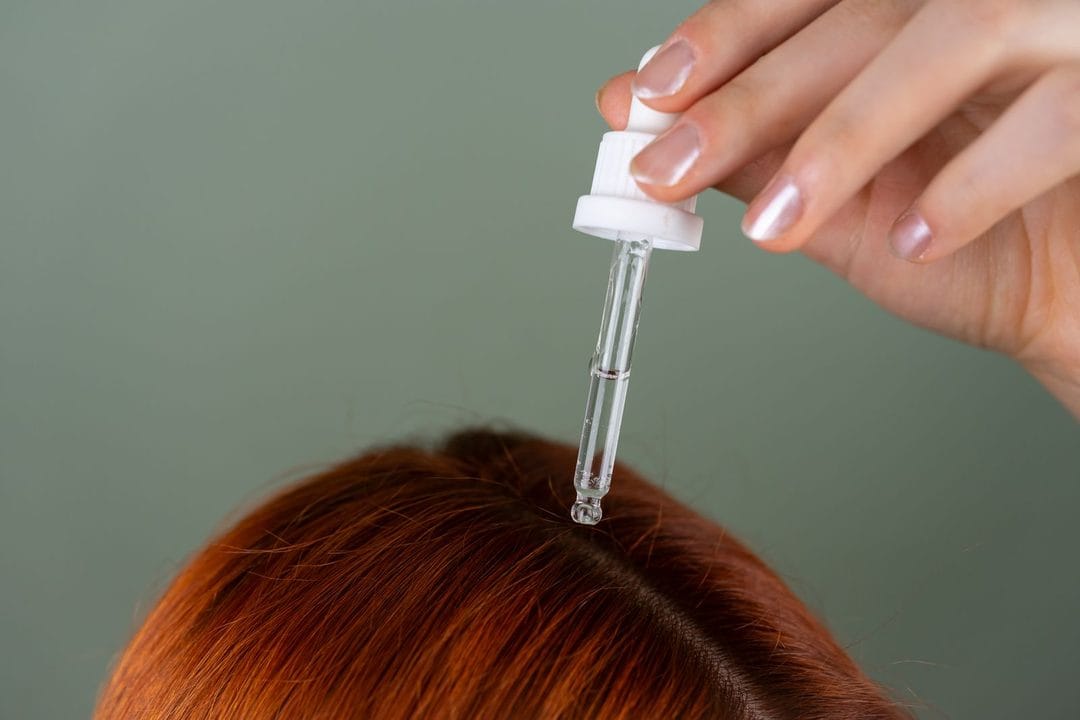
Your part line has started itching around three in the afternoon, right on schedule, the same hour your morning dry shampoo has fully broken down and mixed with whatever SPF spray drifted off your hairline during the walk to work. By evening there's a faint ring of small, tender bumps along the hairline you didn't have in May. You've spent months getting your face routine dialed in — a retinoid, a real SPF, no new breakouts since March — and your scalp decided to fall apart the second the weather turned. That's not a coincidence, and it's not the same problem your face has either. The scalp runs on its own set of triggers, and summer lines almost all of them up at once.
Why your scalp picks summer to fall apart
Skin on the scalp has roughly the same density of sebaceous glands as the face — sometimes higher near the crown — but it's covered by hair, which traps heat, sweat, and product against the surface instead of letting any of it evaporate. In July, most people are sweating into their scalp two or three times a day: the commute, a workout, an afternoon outside. Each time that sweat dries, it leaves behind salt and lipids that mix with sebum, and every layer of dry shampoo or texture spray you add on top gives that mixture something to bind to. Add a sunscreen spray at the part line — sprayed rather than rubbed in, because who's rubbing sunscreen into their scalp — and you've got a third ingredient stack sitting on skin that already can't breathe under the hair.
None of that would matter much in February. Cooler weather means less sweat, less SPF, and days where hair goes unwashed without consequence. Summer removes all three of those breaks at the same time, which is exactly why scalp issues that were dormant all winter — mild seborrheic dermatitis, a tendency toward folliculitis, plain old product buildup — resurface in June and stay through September.
Folliculitis, buildup, and dandruff aren't the same thing
These three get lumped together as "my scalp is acting up," but they need different treatments, and treating the wrong one makes things worse.
- Folliculitis looks like small, uniform, often slightly painful bumps clustered around hair follicles, sometimes with a tiny white center. It's usually bacterial (Staphylococcus aureus) or fungal (Malassezia), and heat plus sweat plus occlusion from product is the exact environment both thrive in.
- Buildup is flat, waxy, and follows your part and hairline — it's product residue and sebum, not an infection, and it usually comes with a dull, weighed-down feel to the hair rather than pain.
- Seborrheic dermatitis (the medical name for stubborn dandruff) shows up as greasy-looking flakes with redness and itching, most often at the hairline, behind the ears, and along eyebrows — it's driven by an overgrowth of the same Malassezia yeast that lives on everyone's skin, just reacting badly in some people.
If you're seeing tender bumps with any pus at the center, that's folliculitis territory and it responds to antifungal or antibacterial washes, not to a heavier conditioner or a gentler shampoo — which is the instinct most people reach for first, and which usually makes bacterial folliculitis worse by adding more occlusive product to already-clogged follicles.
The routine that actually clears it
Start with the wash frequency question, because it's the one people get most wrong in summer. Washing every single day strips the scalp barrier and can push oil production into overdrive; going four or five days between washes during sweaty months lets buildup compound past the point a normal shampoo can lift. The workable middle ground for most people dealing with summer scalp issues is washing every other day, or daily on days with a workout, and treating the scalp itself — not just the hair — as the target of that wash.
For active folliculitis or heavy buildup, alternate a clarifying antifungal shampoo with your regular one rather than replacing it outright. Nizoral A-D (1% ketoconazole, around $16 at any drugstore) is the one dermatologists reach for most often because it's FDA-monograph antifungal and cheap enough to use twice a week indefinitely. Neutrogena T/Gel, built on coal tar, is the better pick specifically for seborrheic dermatitis with flaking rather than folliculitis. If the bumps are tender and look more bacterial than flaky, a benzoyl peroxide wash — the same 4% or 5% concentration used on body acne — applied to the scalp for two minutes before rinsing clears most mild cases within one to two weeks.
Skip the heavy-duty scalp scrub while anything is actively inflamed. Physical exfoliation feels productive, and brands like Briogeo (their Scalp Revival scrub runs about $38) work well as a once-a-week maintenance step once things have calmed down, but scrubbing over active folliculitis just spreads bacteria across more follicles. Save the scrub for the maintenance phase, after two weeks of an antifungal or benzoyl peroxide wash have brought the bumps down.
The sunscreen and dry shampoo problem nobody actually fixes
Spray sunscreen on the part line is close to unavoidable if you're outside for any length of time, but it's also one of the heaviest contributors to summer scalp buildup, because most people spray and never rub it in — which leaves a slick film sitting directly on already-sweaty skin.
The fix isn't skipping SPF at the part line, which is a real skin cancer risk area people underestimate constantly. It's switching to a powder or stick SPF for the part specifically — Supergoop's (Un)seen Sunscreen Stick or a mineral powder SPF applied with a small brush absorbs into the scalp rather than sitting on top of it, and it doesn't need the same rinse-out step a spray does. Dry shampoo deserves the same scrutiny: it's designed to sit on the scalp and absorb oil, which is exactly what it's doing when it turns into a paste with sweat by 3pm. Rinse it out with water on non-wash days rather than layering a second application on top, and use a scalp-specific dry shampoo (Living Proof's Perfect Hair Day or Ouai's) formulated to dissolve more cleanly than the aerosol versions built mainly for volume.
What doesn't work, and what to skip
Apple cider vinegar rinses show up constantly as a scalp fix, and the reality is more mixed than the internet suggests — the acidity can help dissolve some product residue, but it does nothing for bacterial or fungal folliculitis, and using it daily on already-irritated skin tends to make itching worse rather than better. Tea tree oil has genuine antimicrobial properties backed by real research, but only in diluted, cosmetic concentrations (under 5%) — using it undiluted, which some scalp-care content recommends, causes contact dermatitis that looks a lot like the problem it was supposed to fix.
Switching to an entirely "natural" or sulfate-free shampoo line rarely solves buildup on its own. Sulfates are effective surfactants precisely because they lift oil and product residue well, and cutting them out during an active buildup problem usually means switching to a gentler formula that can't actually clear what's already there. Save the sulfate-free shampoo for the maintenance phase once the antifungal or benzoyl peroxide wash has done its job — not as the fix itself.
When it's time to see a dermatologist
Give any of the routines above two to three weeks before expecting real change — scalp folliculitis and buildup don't clear in three days no matter how aggressive the wash. If bumps are spreading past the hairline onto the forehead or neck, if there's visible pus or the area feels warm to the touch, or if two weeks of an antifungal wash hasn't moved the needle at all, that's the point to book a dermatologist rather than keep rotating shampoos. A visit typically runs $30 to $150 depending on insurance, and it gets you either a prescription-strength ketoconazole (2%) or, for genuinely stubborn bacterial folliculitis, a short course of oral antibiotics that over-the-counter washes were never going to reach.
The part line that itches at 3pm isn't a sign your hair care routine failed — it's sweat, SPF, and dry shampoo doing exactly what they're formulated to do, just all stacked on the one part of your skin nobody thinks to treat like skin. Treat it that way for a couple of weeks and most of it resolves before September does.