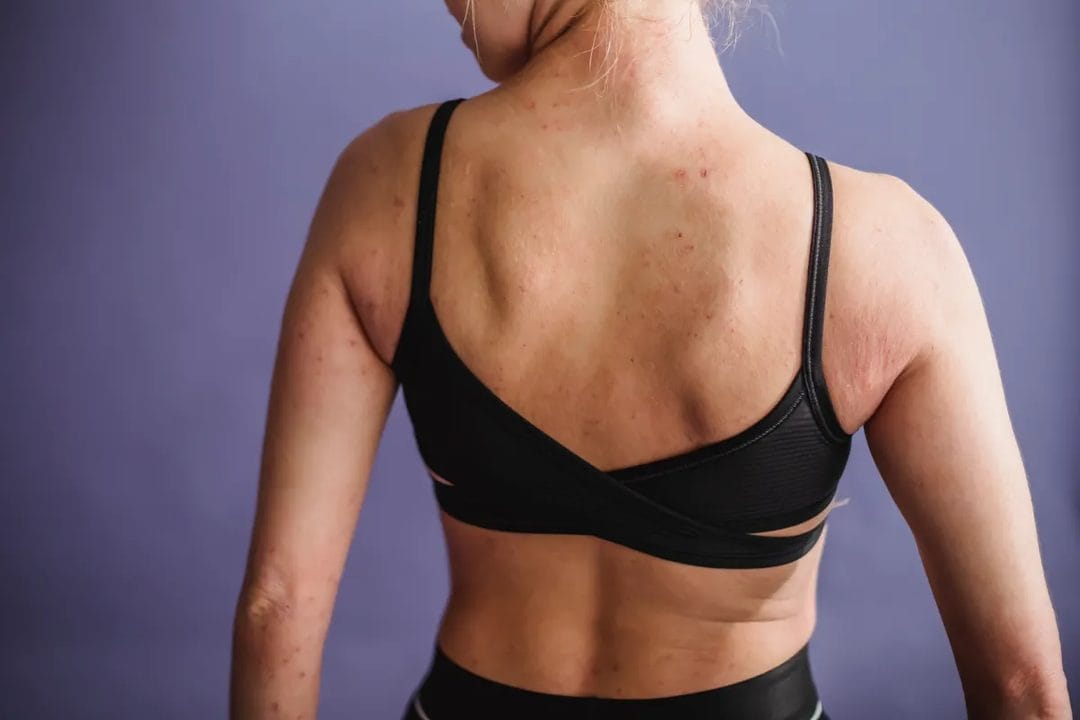
You've finally got your face sorted — cleanser, a retinoid three nights a week, SPF every morning, no drama since March — and then you catch your reflection changing out of a swimsuit and there it is: a scatter of red, sometimes tender bumps across your shoulder blades and chest that wasn't there in April. Nobody warned you that clearing your face has nothing to do with clearing your back. Body acne runs on a completely different set of triggers, and summer is exactly when those triggers line up.
Why chest and back breakouts spike the moment it gets hot
Skin on the back and chest has far more, and far larger, sebaceous glands than facial skin, and those follicles sit deeper under a thicker layer of skin. That combination means oil and dead skin cells get trapped more easily, and it takes more force — mechanical or chemical — to clear them out. Add summer heat and you get two multipliers working at once: sweat production goes up, and so does the time skin spends damp against fabric. Sweat itself isn't acnegenic. What causes the breakout is sweat sitting on skin for an hour under a sports bra strap or a backpack, mixing with sebum and dead skin cells, and clogging a follicle that was already borderline. Dermatologists call the resulting inflammation "acne mechanica" when friction and occlusion are the main drivers, and it looks different from classic hormonal acne — smaller, more uniform bumps concentrated exactly where a strap, waistband or backpack sits, rather than scattered randomly across the back. That distinction matters for treatment, because acne mechanica responds faster to fixing the mechanical trigger than to any serum.
The activewear mistake almost everyone makes
Tight, synthetic fabric is the single biggest preventable trigger, and most people are doing the opposite of what actually helps. Nylon and polyester don't wick moisture away from skin the way the marketing on the tag claims — they trap it against the surface, especially in a fitted sports bra band or compression shorts, for the full length of a workout and often for the commute home afterward. Leggings and sports bras that fit snugly across the chest and lower back create exactly the warm, damp, low-oxygen environment that acne-causing bacteria like Cutibacterium acnes prefer.
Shower within 30 minutes of finishing a workout — not when you get around to it three hours later after errands. That single habit change clears up mild acne mechanica in two to three weeks for a lot of people, no product changes required. If a same-day shower genuinely isn't possible, at minimum change out of sweat-soaked fabric and wipe the area down with a body wipe containing salicylic acid; La Roche-Posay's Effaclar wipes and Neutrogena's Body Clear pads both work for this and cost under $10 for a pack that lasts weeks.
A body-acne routine that actually clears it
Skip the loofah and the exfoliating scrub — for inflamed body acne, physical exfoliation just spreads bacteria across more follicles and irritates skin that's already compromised. What works is a leave-on-then-rinse chemical approach, and the FDA's OTC acne monograph makes it easy to access without a prescription: benzoyl peroxide up to 10% and salicylic acid up to 2% are both approved for over-the-counter sale in the US.
- Start with a 4% benzoyl peroxide wash — PanOxyl's 4% Foaming Wash runs about $10 at Target or CVS and is the concentration most dermatologists recommend starting with, since 10% causes more irritation without clearing skin meaningfully faster.
- Leave it on skin for 2–3 minutes before rinsing; benzoyl peroxide needs contact time to work, and most people rinse it off within 10 seconds, which wastes the product.
- On alternating nights, swap in a salicylic acid body wash like CeraVe SA Body Wash (around $14) to keep follicles clear between benzoyl peroxide sessions — using both every single night is the fastest route to a cracked, stinging skin barrier.
- For stubborn spots that don't respond to washes within four weeks, a leave-on adapalene gel (Differin, sold OTC since 2016) applied to the specific area at night is the better next step, and so on down the strength ladder before anyone needs a dermatologist visit.
Benzoyl peroxide bleaches fabric on contact, including dark towels and pillowcases — use white or old towels for the shower and let the product dry fully before pulling on a shirt.
Sunscreen without making the breakouts worse
Here's the part that trips people up: skipping sunscreen on acne-prone skin because "it clogs pores" just trades one problem for a worse one, since UV exposure thickens the outer skin layer and makes existing acne marks darker and slower to fade. The actual fix is choosing the right formula. Heavy, occlusive body lotions with SPF — the kind marketed as "moisturizing" — are frequently the hidden trigger behind bacne that shows up in June and disappears every October when sun exposure drops.
Choose a lightweight, non-comedogenic mineral or hybrid sunscreen labeled specifically for sport or body use rather than a face formula stretched to cover shoulders. EltaMD UV Sport SPF 50 (about $41 for 3oz) and Supergoop's Play Everyday Lotion SPF 50 are both built to survive sweat without sitting heavy on skin, and neither leaves the greasy film that clogs a strap line within an hour. Apply it to dry skin before getting dressed, not after — sunscreen rubbed onto damp, sweaty skin under tight fabric is close to the worst possible combination for a breakout-prone back.
Laundry and fabric triggers nobody thinks to check
Fragrance and dye in laundry detergent sit against skin all day in a T-shirt or sports bra, and for anyone dealing with unexplained bacne that doesn't respond to a good cleansing routine, switching to a free-and-clear detergent is worth testing before anything else. Fabric softener is the bigger offender of the two — it works by coating fibers in a waxy residue that traps heat and moisture against skin, which is precisely the environment that triggers acne mechanica in the first place. Wash new activewear before wearing it for the first time; manufacturing residues and sizing agents on new synthetic fabric are a documented irritant, and skipping that first wash to save ten minutes is a genuinely common cause of a breakout that seems to appear from nowhere. Switch to Vanicream Free & Clear or All Free Clear, skip the dryer sheet, and give it three washes' worth of workouts before deciding whether it made a difference — one workout isn't a fair test. Pillowcases deserve the same suspicion as gym clothes, since a face and shoulders spend seven or eight hours pressed into the same fabric every night; change pillowcases twice a week during a breakout instead of the usual once. Damp gym bags are the other overlooked culprit — a sports bra left balled up in a bag overnight grows bacteria that a wash cycle alone won't fully remove, so hang it to dry before it goes back in the bag.
When it isn't acne at all
Not every summer bump on the chest or back is acne, and treating the wrong condition with benzoyl peroxide just adds irritation on top of the original problem. Heat rash (miliaria) shows up as small, uniform, often itchy bumps in sweat-trapped areas like under the bra band or where a backpack sits, and it tends to clear within hours of cooling down and drying off — acne doesn't behave that way. Folliculitis, an infection of the hair follicle often picked up from a hot tub or from shaving body hair, looks similar to acne but usually clusters around individual hairs and can come with a faint yellow center at each bump. If a cluster of bumps appeared within a day of a hot tub session or shaving, and each one sits right at a hair follicle, that's more likely folliculitis than acne — a benzoyl peroxide wash still helps, but it won't fully clear a bacterial folliculitis on its own the way it clears true acne.
The two-week check
Give any new body-acne routine two full weeks before judging it — benzoyl peroxide and salicylic acid both work on the skin's natural cell turnover cycle, and turnover takes roughly 28 days even when everything else is going right. Track it with a phone photo in the same lighting once a week rather than checking in the mirror daily, since day-to-day inflammation swings make it nearly impossible to judge real progress by eye.
See a dermatologist if breakouts are cystic, scarring, or spreading despite four to six weeks of a consistent OTC routine — at that point, prescription-strength options like oral doxycycline or spironolactone are genuinely more effective than anything sold at a drugstore, and there's no reason to wait through another summer of it clearing up in October just to have it all come back next June.